The Scoreboard Is the Moat: How to Stop Shipping AI Slop and Start Building a Quality Edge
Build a measurement layer and you stop competing on vibes — you compete on a standard nobody else is running
The paragraph below is AI slop. Read it.
In today’s fast-paced landscape, leveraging AI tools can significantly enhance your productivity and help you achieve your goals more efficiently. By integrating these technologies into your workflow, you can unlock new possibilities and drive better outcomes for your business.
You’ve read that sentence a thousand times, in a thousand LinkedIn posts, with a thousand different nouns swapped in. It’s grammatically correct. It’s tonally confident. It says nothing. And if you’re using AI to produce content at volume, some version of that paragraph is going out under your name — not because you’re careless, but because there’s no mechanism stopping it.
That’s the problem this piece is about. Not the slop itself — the missing gate.
The input-side trap
Everyone who’s noticed slop tries to fix it the same way: better prompts, bigger model, more context, more instructions. Those are all input-side fixes. They make the next generation a little more likely to be good.
The model is non-deterministic. Even a perfect prompt produces slop on some runs. A better prompt is a better coin flip, not a guarantee. And more importantly: no input-side fix includes a step that checks whether what came out is actually good.
The piece missing from every “how do I make AI write better” conversation is: who’s measuring the output? Not skimming it — measuring it. Giving it a number. Building a threshold below which nothing ships.
What a measurement layer looks like
The concept isn’t complicated. Before your AI output reaches an audience, it passes through an evaluation step that:
- Scores the output against a small set of named criteria (4–5 is enough)
- Weights each criterion and computes an aggregate 0–1 score
- Applies a threshold (0.7 works as a starting default)
- Routes: above the line ships, below the line goes back
The criteria do the real work. They’re what distinguish your quality from everyone else’s. Not “is this grammatically correct” — that’s table stakes, and AI clears it automatically. The criteria that matter are things like:
- Actionable. Can the reader do something specific after reading this? Or is it exhortation without a handle?
- Novel. Does this say something the reader didn’t already know? Or is it the kind of thing that appears in every piece on this topic?
- Replicable. Could the reader follow the steps, or does it require expertise they don’t have access to?
- Specific. Is there a named example, a real number, a concrete case — or is it all abstract?
A fifth meta-criterion that earns its place: Would a reader save this to come back to? That one is binary and it filters better than the four above combined.
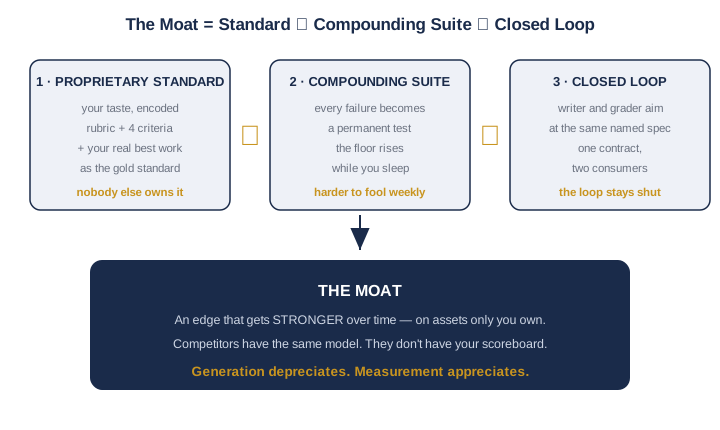
Why this is the moat
Every knowledge entrepreneur using AI is going to have a content strategy. Most of them will try to produce more — faster. They’ll tune their prompts, they’ll try different models, and they’ll produce roughly the same fluent-but-empty material at higher volume.
The practitioner who builds a measurement layer is doing something categorically different. They’re not producing more. They’re producing measurably better — and they have a number to prove it.
That number compounds. Every time you define what good looks like — in criteria, in examples, in a threshold that triggers on your best past work — you’re encoding your taste into a system that runs without you. The standard doesn’t drift when you’re busy. It doesn’t soften when you’re rushed. It doesn’t let the fluent slop through because you skimmed it on a deadline.
The moat isn’t the AI tool. It isn’t the prompt library. It isn’t the content strategy. The moat is the measurement layer, because it’s the only thing that produces compounding quality instead of compounding volume.
The two surfaces that need gates
There’s one conversation happening about AI slop, and it’s almost entirely about content — public-facing posts, emails, articles. That’s worth fixing. But there’s a second surface that doesn’t get talked about, and it’s more dangerous:
Your AI product output. The chatbot on your course site. The “draft my email” feature you built into your offer. The AI intake form that summarizes client responses. That output is your product now — it’s what your clients interact with when you’re not in the room.
When your content is slop, people stop following you. Loud, visible, fixable.
When your product output is slop — wrong format, empty answer, broken response — your clients churn without explanation. Quiet, invisible, expensive.
The gate for product output is the same shape as the gate for content. The criteria are different (correctness replaces novelty, format compliance replaces specificity), but the loop is identical: generate, score, threshold, route. The silent surface is worth at least as much attention as the loud one.
How to start
You don’t need a system. You need a standard and a habit.
For content: Pull your five best past pieces of one kind. Write down the four things they all do. Score your next draft against those four before it goes out. Average the scores. Set a line at 0.7. Below the line doesn’t ship — you fix the lowest-scoring criterion and re-score.
For product output: Write 20 real inputs with the correct outputs. Run them every time you change a prompt or a model. If the aggregate score drops, you caught a regression before a client did.
That’s the measurement layer. Not a platform, not a folder structure, not a specialized tool. A defined standard, a score, and a threshold. Everything else — the architecture, the automation, the recurring gate — you build when you have enough signal to know what’s worth building.
The moat starts with the habit. The system is the habit that got too important to do by hand.
Key takeaways
- Slop is an output-side problem. Input-side fixes (better prompts, bigger models) improve the odds but never check the result.
- Quality needs a number. “Seems better” misses the bad run hidden in the next fifty. A 0–1 score against named criteria doesn’t.
- Your criteria are the moat. Generic quality is table stakes. The standard built from your best past work is yours.
- The silent surface is more expensive. Bad content embarrasses you publicly; bad product output churns customers without a word.
- The standard compounds. Every time you encode what good looks like, the floor rises — without you raising it manually.
Coach Lou D’Alo is the founder of AIMM — the AI Mastermind for Knowledge Entrepreneurs. He works with coaches, consultants, and course creators who want to build intelligence infrastructure, not just content pipelines.