I Asked for an Eker-Style Rewrite “Just for Fun.” It Became a Permanent Voice Profile.
How a throwaway request surfaced a way to steal a writer’s energy without inheriting what’s wrong with their substance — and turned into a reusable Grounded Challenger voice anyone on the team can now load.
I had just finished an article in my own voice. It was good. I shipped it.
Then, on instinct, I typed: “Just for fun, write me a version combining the experience-insight-guide with a mix of Harv Eker written style and tone (not the wealth-mind structure, just the writing voice).”
It was meant to be a curiosity exercise. What came back was punchier than my own version. I read it twice and realized I wasn’t done with it — I wanted that energy as a permanent option, not a one-off. The next ninety minutes turned into building a voice profile from scratch: naming what to steal from Eker, naming what to leave behind, and finding a structural rule that made the borrowing safe.
What I want to walk through is how that decoupling actually worked. The mechanics of a voice can be extracted from the substance of a voice — but only if you can name both clearly enough to separate them.
The rewrite — what came back, and what made it land
The Eker blend article hit harder than my own version. When I asked Claude what it had actually done, the answer was specific:
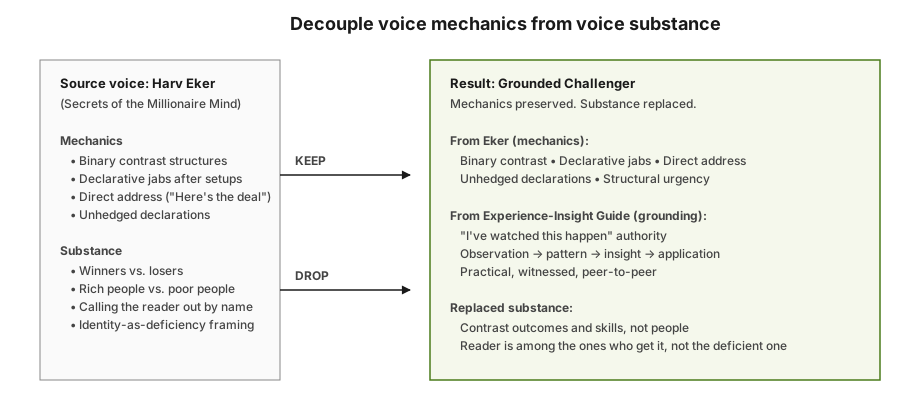
Voice blend mechanics:
From Eker: binary contrast structures, direct confrontational address, “Here’s the deal” energy, short declarative jabs after longer setups, unhedged declarations, calling the reader out by name.
Held from Experience-Insight Guide: observation → pattern → insight → application spine, “I’ve watched this happen” grounding, practical application that hands the reader something specific.
The tension that makes the blend interesting: Eker wants to tell you what successful people do; Experience-Insight Guide wants to show you what the writer has actually seen. Together: personally witnessed + structurally urgent.
That paragraph is what made me realize this was worth turning into infrastructure. The blend wasn’t a stylistic accident — it was a specific composition. Eker brought structural urgency. Experience-Insight Guide brought witnessed authority. Each one alone had a known failure mode (Eker reads as gimmicky without grounding; Experience-Insight Guide reads as soft without urgency). Combined, they covered each other’s weaknesses.
But there was a problem buried inside the Eker side. I knew it the moment I read it back.
Concept #1: When a blend works, name what each source is contributing — and what each source’s failure mode is. A voice blend isn’t a vibe. It’s a composition of two known styles, each chosen to cover the other’s weakness. If you can’t name what’s failing in each source alone, you can’t tell when the blend has stopped working either.
The problem hiding inside the Eker mechanics
Eker’s voice runs on contrast — and the contrast is almost always people. Rich people do this; poor people do that. Winners do X; losers do Y. The reader is invited to recognize themselves on one side of the line and feel a small jolt of inadequacy on the way to changing.
In a seminar, with an audience that’s signed up to be told they’re wrong, that works. In a written piece aimed at peers — knowledge entrepreneurs, operators, people who already pay for their own admission — it doesn’t. The same mechanic that makes Eker’s seminar energy contagious is the one that makes him sound condescending on the page.
The blend I’d just read still had that residue. I named it: “the winner/loser problem in Eker is something we don’t want to inherit.” Then I asked for alternative framings.
Concept #2: Separate a voice’s mechanics from its substance before you borrow. Mechanics are the sentence patterns, rhythm, and structural moves. Substance is what those patterns are pointed at. You can keep the mechanics and replace the substance — but only if you can articulate which is which.
Four framings, then a selection rule that made one redundant
Claude came back with four options for contrast framing that don’t pit reader against villain:
- Field Observation Frame. Depersonalize. Reader is the observer of two kinds of operators, not one of them.
- Forward-Facing Frame. Always point at where the reader is going, not where they’ve been.
- Outcomes Focus. Remove people entirely. Contrast trajectories, not actors.
- Peer Frame. Address the reader as already among the ones who get it; the contrast is with people not in the room.
I pushed back on the initial recommendation. Option 1 (Field Observation) had something the others didn’t — it gave me a way to talk about people without making the reader the loser. Sometimes the contrast really is between two kinds of operators, and trying to abstract that into trajectories flattens the point.
Then I noticed the actual rule sitting underneath my preference: the subject of the contrast should determine the framing. If I’m contrasting people, Field Observation. If I’m contrasting outcomes, Outcomes Focus. Same skill, two settings, one selector.
That’s what made the voice profile shippable. Not a list of four options to pick from manually — a single decision rule the writer applies once per contrast.
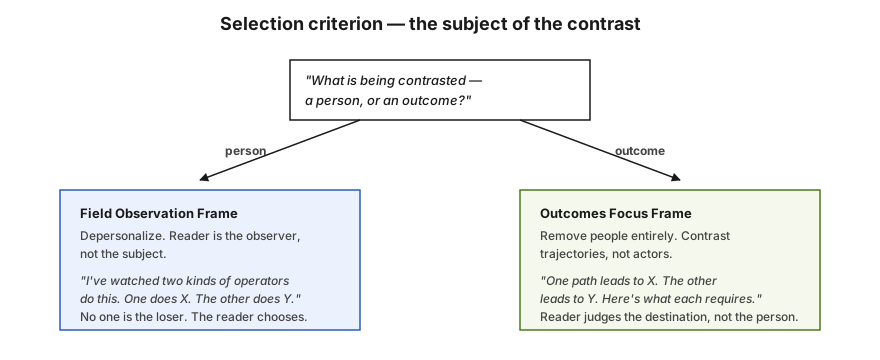
Concept #3: Replace a menu of options with a selector. A list of “things to consider” is a decision deferred. A rule of the form “if X, use A; if Y, use B” is a decision delegated to the structure. When borrowing from another voice, prefer the selector.
Naming the voice — Grounded Challenger
With the selector in place I needed a name. The blend had two clear DNA strands:
- Grounded — from Experience-Insight Guide. Authority earned from observation. “I’ve watched this happen.” Witnessed, peer-to-peer, not borrowed from a podium.
- Challenger — from Eker. Direct, declarative, unhedged. Structural urgency. The reader feels pushed.
Grounded Challenger. Two words, each pointing at one parent. Neither word referenced Eker or the source material directly — the name described the posture, not the lineage. That mattered because the voice was going to be used by people who’d never read Secrets of the Millionaire Mind and didn’t need to.
Concept #4: Name a borrowed voice by its posture, not its lineage. Naming it after the source ties the voice to a creator the reader may not know or may dislike. Naming it by the posture (what the voice does to the reader) makes it usable by anyone on the team without baggage.
The extension — three layers of contrast
I thought the voice was done. Then I said one more thing:
“When we’re talking about outcomes, we can also talk about the skills or knowledge. Here are the outcomes, here are the failed outcomes, here are the successful ones, and then the skills that create the non-ideal outcome versus the skills that create the successful outcome. There’s the outcomes, there’s the skills, and then there’s the identity layers.”
That broke the voice profile open in a useful way. The two-mode selector (people vs. outcomes) had been incomplete. There were actually three layers a contrast could operate on:
Layer 1 — Identity. The self-concept that drives which skills a practitioner develops.
Layer 2 — Skills/Knowledge. The mechanism layer. Missing a technique is neutral.
Layer 3 — Outcomes. What each path produces downstream.
Causal direction: Identity → Skills → Outcomes. But the writing direction doesn’t have to match. You can write forward (root to result), or reverse (result to root). Reverse is often more powerful — hook with the outcome, hand the reader the technique gap, land on the identity shift that makes the change permanent.
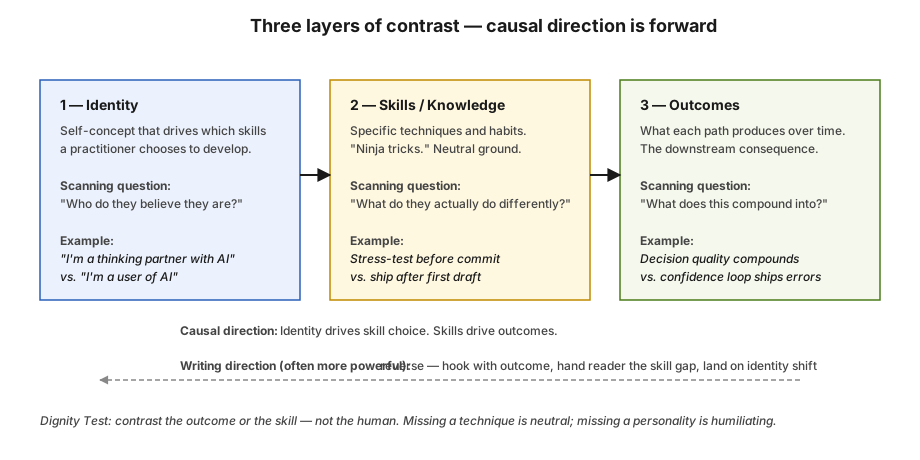
Concept #5: Separate causal direction from writing direction. Causality runs one way. Persuasion often runs the other way. Hook at the consequence the reader cares about, walk back to the mechanism, land on the identity that makes the mechanism stick.
The Dignity Test — one line that protects the whole voice
The three layers gave me an upgraded selector. But I also wanted a guardrail — something that prevented the voice from drifting back into the Eker failure mode under pressure.
The rule I added:
Dignity Test: Contrast the outcome, or the skill, or the identity the reader can choose to step into — never the identity the reader currently inhabits as a deficiency. Missing a technique is neutral. Missing a personality is humiliating.
One sentence, applied as a final pass. If the draft contrasts two kinds of people in a way that makes the reader the worse one, it fails. Either reframe to contrast the outcome or skill, or pivot to identity-as-aspiration (who the reader can become) rather than identity-as-deficit (who the reader has been).
Concept #6: Add a guardrail at the boundary the voice is most likely to violate. Every borrowed voice has a known drift direction. Name it, then write a one-line test that catches the drift on review. The test should be specific enough to fail a draft — not a principle, an operation.
The transferable pattern
The method for borrowing from any creator whose energy you want but whose substance you can’t ship:
- Notice when a blend works. Don’t dismiss “just for fun” outputs. The throwaway often reveals what your default voice is missing.
- Name what each source contributes — and each source’s failure mode. If you can’t name the failure mode, you’ll inherit it.
- Decouple mechanics from substance. Mechanics are the sentence patterns, rhythm, structural moves. Substance is what those mechanics point at. You can keep one and replace the other.
- Replace problematic substance with a selector, not a list. A selector is a one-line rule the writer applies automatically.
- Name the voice by its posture, not its lineage. Free it from the creator.
- Add a Dignity Test at the boundary the voice is most likely to violate. Voices drift toward their parents under pressure. The test is the line that catches the drift.
Key takeaways
- “Just for fun” requests can produce more durable artifacts than the main deliverable. Take them seriously when something surprising comes back.
- A voice blend is a composition, not a vibe. Each source covers the other’s failure mode.
- Mechanics and substance can be separated. Sentence patterns, rhythm, and structure are portable. What those patterns are pointed at may not be.
- Three layers of contrast (identity / skills / outcomes) give you more control than two.
- The Dignity Test catches drift. One line, applied on review. Specific enough to fail a draft.
— Lou